
Table of Contents
What Makes Jenkins and Docker Essential in a DevOps Certification
Introduction: The Real Backbone of Modern DevOps
Let’s be honest: you can’t call yourself a DevOps professional without Jenkins and Docker. These tools are vital for modern automation. One keeps the pipeline running. The other makes sure your code works in different environments. Each year, thousands of engineers in India seek DevOps certification. They want to master automation and deployment. Yet, many still feel unsure about launching real projects. That’s where Jenkins and Docker excel.
This isn’t another list of tools. It’s about why every serious DevOps course must teach them and how they shape the future of IT delivery.
1. What Makes Jenkins and Docker Essential in a DevOps Certification
Let’s start with a simple truth: automation is the heart of DevOps. Collaboration and delivery are important, but without automation, they remain ideas. That’s where Jenkins and Docker come in. They’re not tools; they’re the engines that make DevOps work.
Jenkins automates repetitive tasks, turning complex workflows into smooth, repeatable processes. Docker ensures your builds work the same way everywhere—on your laptop, a testing server, or in the cloud. They connect code and delivery, speeding up processes from hours or days to minutes.
| Tool | Primary Function | DevOps Skill Gained |
| Jenkins | Automates builds, testing, and integration | Continuous Integration (CI) mastery |
| Docker | Packages and runs applications in containers | Environment consistency and scalability |
2. Understanding Jenkins: The Engine Behind Continuous Integration
Think of Jenkins as the workhorse that turns manual steps into reliable automation. It does more than “run builds.” It handles everything from code commit to deployable artifact.
How Jenkins Works
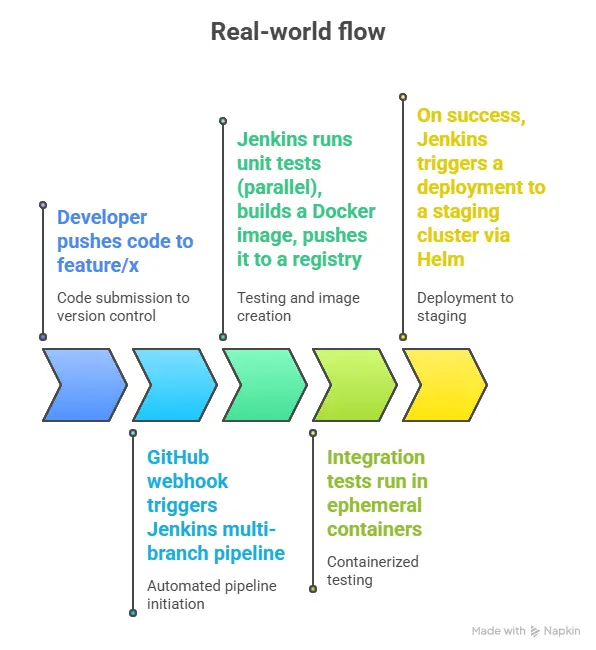
- Controller and Agents: Jenkins has a central controller (the brain) and multiple agents (workers). The controller schedules jobs; agents run them. This setup lets you distribute heavy tasks and scale as your team grows.
- Webhooks & Triggers: Jenkins listens for events from source control. A push to GitHub or Bitbucket can trigger a build instantly via webhook—no manual clicks required.
Pipelines as Code — Why It Matters
- Jenkinsfile: Define the entire pipeline in a Jenkinsfile stored with your repo so pipeline changes are versioned and reviewable via pull requests.
- Declarative vs. Scripted: Declarative pipelines are readable for common workflows; scripted pipelines are flexible for complex logic. Start with declarative.
- Stages & Parallelism: Divide work into stages (build, test, package, deploy). Jenkins can run stages in parallel to speed up builds.
Integrations That Make Jenkins Powerful
- Build Tools: Maven, Gradle, npm — Jenkins runs tests and fails fast if something breaks.
- Containers & Docker: Jenkins can build Docker images, run tests in containers, and push images to registries.
- Orchestration: Jenkins can trigger Kubernetes, Helm, etc., to deploy images into staging/production.
- Artifacts & Registries: Integrate with Nexus, Artifactory, or AWS ECR to store build artifacts reliably.
Jenkins also provides visibility: logs, notifications (Slack, email), pipeline visualization (Blue Ocean), and best practices like ephemeral agents, caching, and secure credential handling.
3. Docker in DevOps Certification: The Power of Containerization
Docker transformed how teams build and ship apps with containers — lightweight, self-sufficient packages containing code, libraries, dependencies, and configuration. Docker solves the “It worked on my machine!” problem by creating identical environments everywhere.
In a DevOps certification that includes Docker training, you’ll experience real-world reliability. Docker streamlines CI/CD pipelines, reduces configuration errors, and speeds up delivery.
| Benefit | How Docker Solves It |
| Environment inconsistency | Containers replicate the same setup everywhere |
| Slow deployment | Instant container startup accelerates release cycles |
| Cost inefficiency | Resource sharing cuts infrastructure costs |
4. How Jenkins and Docker Work Together in a Real CI/CD Pipeline
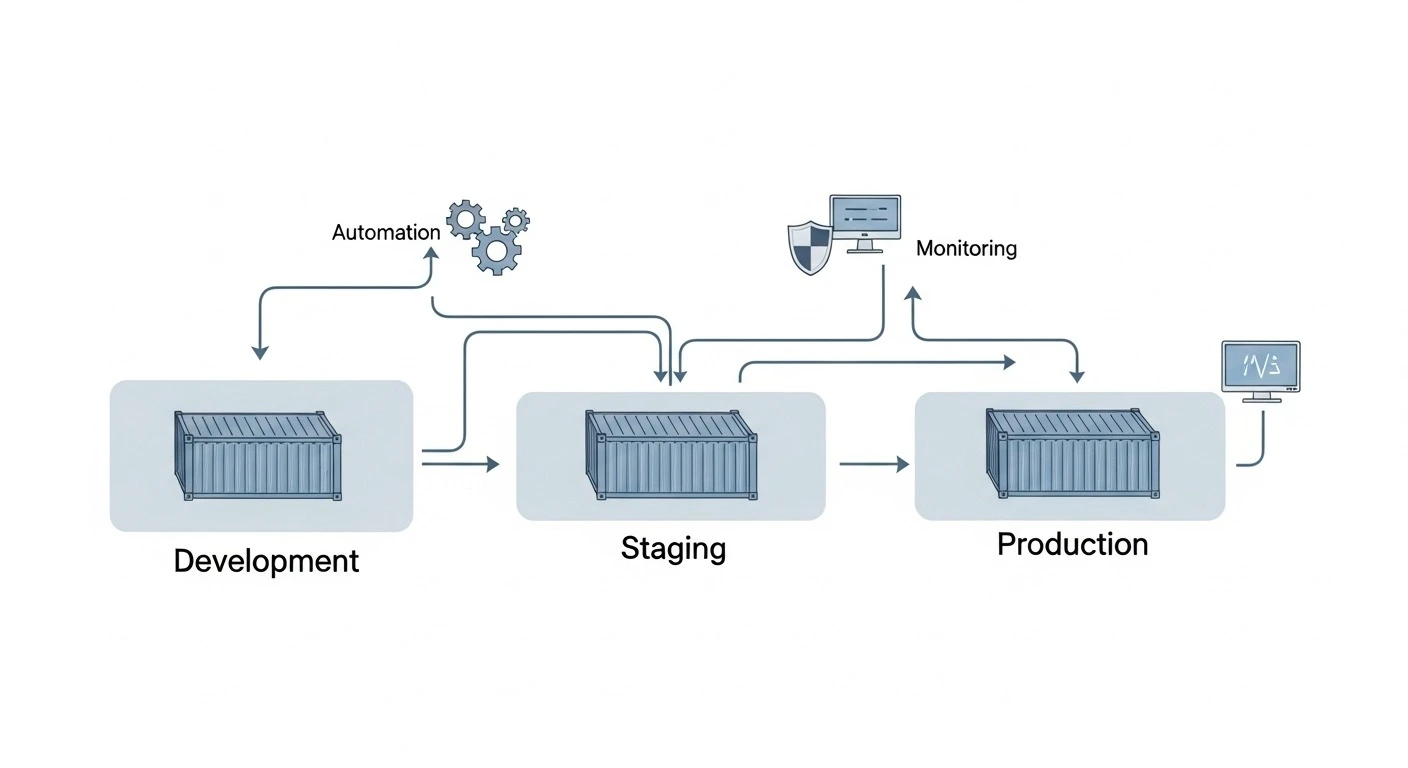
Jenkins automates the pipeline; Docker ensures consistency. Typical flow:
- Code Commit: Developer pushes code to Git.
- Jenkins Trigger: Jenkins detects the change and starts a build.
- Docker Build: Jenkins creates a Docker image of the app.
- Testing Phase: The image is tested in isolated containers.
- Deployment: Successful builds are pushed to production environments.
This combination builds the core capability every DevOps professional needs — a fully automated CI/CD cycle from commit to delivery.
5. Why Most Online DevOps Courses Miss the Mark
Many online DevOps courses shy away from deep dives into Jenkins and Docker because mastering these tools takes time and effort. Instead they offer theory-laden modules and shiny certifications. The outcome: learners can talk about DevOps but stumble when automating a pipeline.
A true DevOps certification should include hands-on Jenkins labs, Docker image crafting, cloud integrations, Git workflows, IaC like Terraform/CloudFormation, monitoring/logging, DevSecOps, collaborative projects, and a structured roadmap from beginner to expert.
6. Jenkins + Docker Skills: The Real-World Advantage in India
India’s tech landscape demands speed, scalability, and efficiency — exactly what Jenkins and Docker provide. Companies seek DevOps engineers who can streamline pipelines using these tools.
| Industry | Use Case | Tools |
| Fintech | CI/CD pipelines for real-time apps | Jenkins + Docker |
| E-commerce | Container orchestration for microservices | Docker + Kubernetes |
| Cloud Services | Deployment automation | Jenkins + AWS |
7. FAQs
Q1: Why is Jenkins vital for a DevOps certification? Jenkins teaches automation — the backbone of CI/CD pipelines.
Q2: Is Docker essential for DevOps professionals? Definitely. Docker ensures applications perform consistently everywhere and is crucial for scalability.
Q3: Which is superior — Docker or Jenkins? Neither — they’re complementary: Jenkins automates; Docker deploys.
Q4: Can I learn Jenkins and Docker in an online DevOps course? Yes — reputable platforms offer lab-based modules for both tools.
Q5: Do Microsoft DevOps certifications include Jenkins and Docker? Some do, but many focus on Azure tools — extra Jenkins & Docker training is valuable.
8. The Future of DevOps Training Lies in Integration
The next wave of DevOps isn’t about amassing tools — it’s about forging connections. A solid DevOps certification should let you experience how Jenkins and Docker shift theory into application.
When Jenkins automates builds and Docker creates consistent environments, real-world DevOps becomes seamless, quick, and reliable — the leap from knowing DevOps to living it.

At Paperlive Learning, our DevOps certification helps you build, automate, and deploy with confidence. Jenkins and Docker are not mere buzzwords — they have become the new standard. Join today — your DevOps success story starts here.
Paperlive Learning
Master automation and containerization with Jenkins and Docker.